psychoanalysis and football - what's loss got to do with it?
12 February 2026
English football has a wellyfull of tragic stories. The sport is arguably built on stories of loss on and off the pitch, as much as it is of winning. It makes clubs identities, cements loyalty, bonds in collective grief, lasting decades. And when loss, especially regarding death, is not attended to, it haunts.
Here’s a big story about a thumping loss off the pitch. In February 1958 a young football team full of talent and potential were favourites to win the European Cup after having easily won the English top league by eight points having only been just knocked out of the previous year’s European Cup by eventual winners Real Madrid. The team were then in Belgrade battling and coming out on top against a strong Red Star Belgrade team, drawing 3-3 in the quarter final second leg, but winning on aggregate. Returning to England they flew via Munich to refuel. On take off, the plane crashed. It killed 23 of the 40 passengers. Three of the dead were club staff, the president, a trainer and a coach. Eight were players nearly all under 25: Billy Whelan (aged 22), Duncan Edwards (21), Eddie Coleman (21), Tommy Tailor (26), David Pegg (22), Mark Jones (24), Roger Byrne (28) and Geoff Bent (25). Last weekend saw the 68th anniversary of the disaster; the day Manchester United, the best team in the English league, was scythed in two. Half dead, half alive. On Saturday, the disaster was remembered and a huge banner unfurled over hundreds of heads. It read ‘We’ll Never Die’.
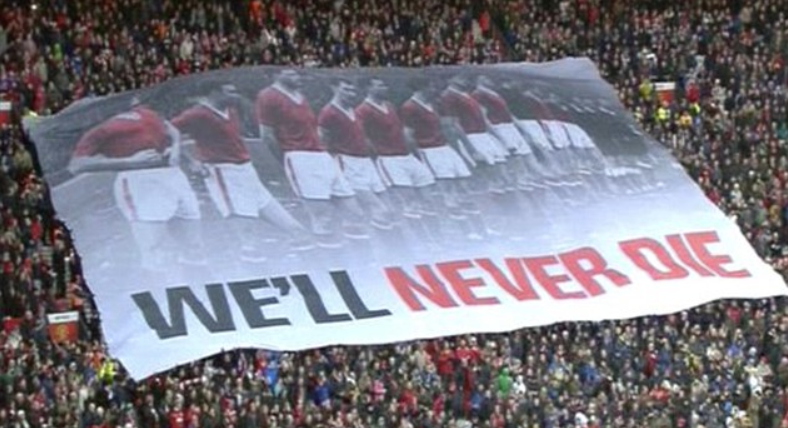
Loss, dying, grief are not things you want to shout about from the stands, are they? Loss is not what clubs look to in solving intractable problems on the pitch. Should they? And if so why not turn to psychoanalytic thinking to do so? No, psychoanalysis, a study of loss, lack and grief, is not something a football club would pay hundreds of thousands of pounds for. And here’s why. Football is about winning. Psychoanalysis is not really much to do with winning. It’s about its exact opposite.
We’ll Never Die…. It is important to remember that half of those players 68 years ago did die; horribly, tragically. Not gloriously. The fans remember, but it’s not clear the club does any longer. So long ago this team had to play on with the surviving half still believing it was whole. The potential of this team was massive. Alongside actual death of young men, future aspirations and a winning trajectory was lost to fantasy and magic and in some sense neither lived nor ever died. Things don’t in fantasy. Half the great Manchester United team of 1958 were no-longer great. Regardless of how much sympathy and love there was for this team and the significant talent that remained, in reality they were half a team and because of that, not nearly as good.
The current iteration of Manchester United, 68 years on, appears to gobble up talent and then spit it out. Players and managers come and get worse. Players leave and seem to get better again playing elsewhere. There are moments of reprise and joy of this team returning to win like the great teams of the past - as with the current run of games - but usually these appear like momentary hiccups in a series of failures. A frustrating stuckness persists. Amongst all of this a there is a magic to Manchester United, an identity of greatness even when the team is not. It’s obvious how it is a plus point to have a refuse-to-die-mentality. But at what cost does this fantasy hold? Psychoanalytic thinking is not something to be thrown about from afar. Effective change comes at the point where something lost to fantasy is symbolised and brought into contact with the world. This has to be done by the people living in it, the staff and the players of a club, to grasp what it is that needs to be spoken about and rethought - and to embrace a new identity and a new future, by speaking of the past.
The focus for psychoanalysis is to symbolise loss, partially to make sense of it, and partially to find some way to accept it as a part of what makes me, me, or Manchester United, Manchester United. We mourn death by grappling with our inevitable wish to deny death (we will never die), to think magically, and eschewing anything reminding us that it is so frighteningly final. This results in a frozen state. This is the costs of in a collective fantasy, in the minds of the players and the people involved in the club to keep the Great Manchester United alive. To keep the young men of 58 alive, to keep the Giggs, the Scholes and the Beckhams young and in their prime (age is a different kind of loss). Whether an individual or a group of individuals, to keep alive someone or something long dead causes limits to be ignored. Poor choices made. Things are not done. And we do not win because we are half blind. To keep the ‘We will never die’ spirit, there is a high cost, which psychoanalytic thinking understands well.
Speaking this weekend, Michael Carrick, the Manchester United caretaker manager, spoke about playing under Alex Ferguson, and how important it was for players know the history of the history of the club and speak about this. Alex Ferguson oversaw arguably the best ever Manchester United side, a side built on a core of talented youth who were good and did not die in tragedy. He was not just a uncompromising and scary crackerjack of a manager. He also demanded the history of the club was understood and respected by the players. No longer enough to just go out and wear the shirt, players needed to know the context of the group they were playing for and the stories - and the loss - it was built upon. This is not psychoanalysis per se but it does have elements that make it successful psychoanalytically. Alex Ferguson may have stumbled upon (or consciously appreciated) how our representations and symbolisation of loss can lead to creativity and development. And how when we are unaware of what we have lost, we carry over something that destroys our ability to win. To run this club and find a new form of Manchester United, an appreciation of history and an injection of psychoanalytic thinking might after all be a decent fit.